

Water scarcity is increasingly shaping the future of tourism and hospitality. As global tourism grows and climate pressures intensify, hotels operating in water-stressed destinations face rising operational, financial, and reputational risks.
The Destination Water Risk Index (DWRI) is a global water risk assessment developed to help the hotel industry and destinations understand, quantify, and respond to water-related risks.
First published in 2018 and expanded in its 2023 edition, the DWRI now covers 379 destinations across 63 countries, featuring enhanced metrics that evaluate each destination’s exposure to physical, financial, and market risks related to water availability and management challenges.
Greenview led the development of the DWRI, bringing together data science, sustainability analytics, and hospitality-specific insights to create a practical tool for hotel companies, investors, and destinations. This was in collaboration with STR (a CoStar Group Company) and Ecolab. The World Sustainable Hospitality Alliance supported the initiative and facilitated its publication.
Purpose and Impact
Water scarcity and management are becoming critical issues for tourism growth and hotel operations.
The DWRI provides a foundation for data-driven water stewardship, enabling hotel companies, property teams, developers, and destinations to:
- Prioritize action in high-risk areas
- Integrate water risk into sustainability and investment strategies
- Identify opportunities for collaboration with local communities and governments
- Upgrade on-site water management and infrastructure to mitigate risks
Key Findings
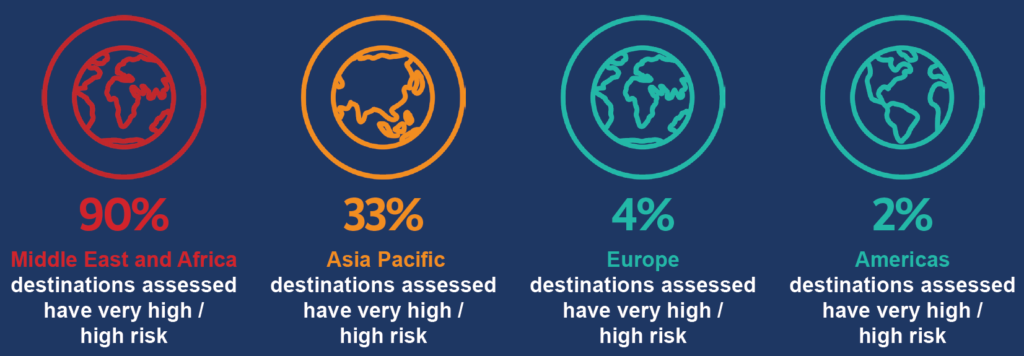
The research highlights several important trends shaping water risk in global tourism destinations.13% of global destinations assessed face high or very high water risks, with significant variations across regions as shown below.
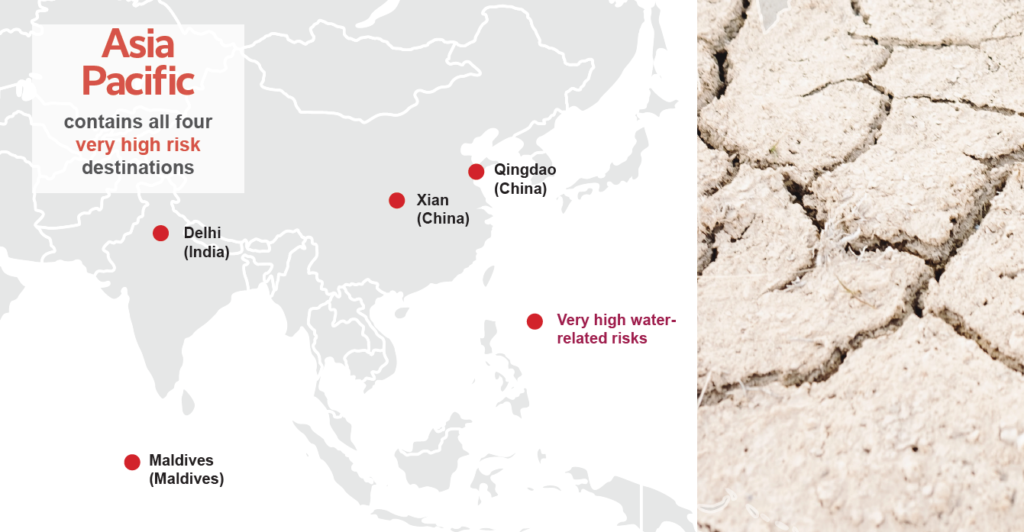
In particular, our analysis showed four destinations facing very high water-related risks, including Delhi, the Maldives, Qingdao, and Xi’an. These locations are where pressures on water resources are already severe and where the hospitality industry must accelerate efforts to strengthen water stewardship.
These findings underscore the urgent need for collective industry action in regions where tourism growth and water scarcity overlap. Many destinations projected to experience the greatest increases in tourism demand are also among those expected to face the highest levels of water stress in the coming years. This underscores the importance of prioritising water risk management in rapidly expanding tourism markets.
Hotel developers, investors, and destination management organizations should also consider the implications of future hotel supply in the pipeline. New developments can significantly increase water demand in destinations already facing constrained resources. Integrating water risk assessments into development planning and destination strategy will therefore be essential to support sustainable tourism growth.

Our Methodology
The DWRI factors in multiple datasets, including nine metrics spanning physical, financial and market risks:
- Baseline water stress – Measures current pressure on local water resources by comparing total water demand with available supply.
- Seasonal variability – Indicates how much water availability fluctuates throughout the year, showing how predictable or unstable supply is.
- Future water stress – Projects how competition for water resources may change in the future based on expected demand and supply.
- Incoming risk likelihood – Estimates the probability that risks will increase operating costs due to scarcity, regulation, or tariff changes.
- Revenue at risk – Calculates the potential financial losses businesses may face due to operational disruptions.
- Water intensity (litres per occupied room) – Measures typical hotel water consumption per occupied room.
- Hotel pipeline % of supply – Indicates how much new hotel development is planned relative to existing hotel capacity in a destination.
- Population – Reflects the size of the local population.
- Tourism contribution (% of GDP) – Shows how economically dependent a destination is on tourism activity.
Explore the Research
Go Beyond Water Risk
Water risk is only one dimension of the environmental and climate risks facing the hospitality sector.
Greenview works with leading hotel companies worldwide to help them identify, assess, and manage ESG and climate-related risks across their portfolios.
Explore our Risk Assessment Services.


